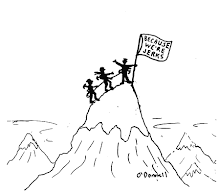
People don't know what they don't know, of course, but once in a while my social worker positive regard slips a little and I have a "what are you THINKING?" moment.
I wish I could quote the letter a client's mother wrote for him because, well, I read it in little bursts, unable to process entirely how wrong it is. It was at once somewhat funny and very disappointing since I really, truly can't use it, and in fact it's so off track for what you'd want to write to a judge to say good things about your kid that I don't know if I can even really call and say "could you leave in X and take out the rest?" because all of it I've read so far is unusable.
I have a sheet of suggestions I send people home with sometimes, and I think one thing I'm going to add to it is: don't use big words, and try to write mostly in short sentences. I don't know how else to say it without coming off as a horrible snob. Of course what I mean is "don't be fancy unless you're very sure of what you're doing or you're just going to sound like a dope."
Ok, I read the rest of it. Some of it is fine and most of it is not. And it lists a CC to the Assistant District Attorney which I hope is just another affectation and she didn't actually send it because augh.
Thursday, January 24, 2013

Wednesday, January 23, 2013
Oh hi
I guess I abandoned this altogether. I'm back, maybe, because I'm thinking about some job transitions and also a mad burnout case and may need space to "ventilate affect" if that term can be expanded to include screaming and setting things on fire.
Exasperation du jour: The fact that my job puts me in the position of being brittle and officious to wage slaves in records rooms is taking some years off my life. I just said "it's a little bit troubling to me" in the smarmy tone you would expect for those words to someone who was being perfectly pleasant because it appears for the millionth time my release for information to help with someone's court case, a thing that has a specific date, has fallen into the void.
I would hate to work in a records room. It sounds like a nightmare, like that David Foster Wallace story in the New Yorker where he works for the IRS, checking people's tax forms. I didn't make it through that and I wouldn't make it through a month working in a records room but this does not really help me when I'm on the other end of the equation, sending releases, calling repeatedly, having people do the telephonic equivalent of staring at me helplessly and blinking, and then I have to go back to an attorney and say "I don't have the records yet."
This should be simple. This should be the mindless part of the job. Instead it is the ruinous part. Today I'm calling a different records room and offering to go up there physically and pick up the records because they simply don't seem to care at all. My fax cover sheets have gotten more and more huffy. Did I really just say that? Is that what my job has turned me into. My fax cover sheets have gotten more and more huffy.
Does anyone have a match?
Monday, January 10, 2011
Doubts
You know what I hate more than anything else in working life? Reading a 2000-page stack of ACS records is what I hate more than anything else in working life. And they always seem to come in 2000-page stacks.
Nothing good can come of any endeavour that generates this kind of paper trail.
Nothing good can come of any endeavour that generates this kind of paper trail.
Thursday, January 6, 2011
That day will come.
I imagine this to be the perfect lyric expression of my client's experience.
To this we've come,
That men withhold the world from men
No ship, no shore for him who drowns at sea,
No home nor grave for him who dies on land.
To this we've come,
That man be born a stranger upon god's Earth
That he be chosen without a chance for choice;
That he be hunted without the hope of refuge.
To this we've come. To this we've come.
And you, you too shall weep
If to men not to god we now must pray
Tell me secretary tell me, who are these men?
If to them not to god we now must pray
Tell me, secretary, tell me:
Who are these dark archangels?
Will they be conquered?
Will they be doomed?
Is there one, anyone behind those doors
To whom the heart can still be explained
Is there one anyone who still may care?
...
Oh, the day will come I know
When our heart's a flame
Will burn your paper chains
Warn the consul, secretary, warn him
That day neither ink nor seal
Shall cage our souls
That day will come.
That day will come.
[Patricia Neway performs Magda Sorel's aria "To This We've Come" from the Giancarlo Menotti's The Consul. It is a melodramatic reading but I can't find much fault in it. It ends around 7:50 but the poster has included more of the piece.]
Today I met with two of those clients who remind me that my purpose is little more than to answer the question: can this person find a place in society? It's about capitalism as much as it's about anything. The fellow this morning is caught between his inutility the cost of containing him. He's cognitively barely there and reads as likely having no impulse control, not things you can do a lot about at age twenty. He's fucked. His day will not come.
The one this afternoon is pretty likely to die in prison if the ADA is having a bad day. It never really comes down to risk of recidivism--I'd be a fool to make many pronouncements on people's future--but this guy looks too frail to do much now. He's here because, I don't even remember fully, some kind of squabble with someone else the ADA and the aggregate vulnerable public would doubtless recoil from. The fear is not what they'll do to each other, but whether their bullets will go astray. We punish them mostly to exorcise the fear, because unless you're going to throw almost everybody in jail, it's going to happen anyway. And I think you kind of have to leave 51% of us unincarcerated or things get tricky.
This squeak of anguish brought to you by my day. Perhaps I'll try and blog a little more here again.
To this we've come,
That men withhold the world from men
No ship, no shore for him who drowns at sea,
No home nor grave for him who dies on land.
To this we've come,
That man be born a stranger upon god's Earth
That he be chosen without a chance for choice;
That he be hunted without the hope of refuge.
To this we've come. To this we've come.
And you, you too shall weep
If to men not to god we now must pray
Tell me secretary tell me, who are these men?
If to them not to god we now must pray
Tell me, secretary, tell me:
Who are these dark archangels?
Will they be conquered?
Will they be doomed?
Is there one, anyone behind those doors
To whom the heart can still be explained
Is there one anyone who still may care?
...
Oh, the day will come I know
When our heart's a flame
Will burn your paper chains
Warn the consul, secretary, warn him
That day neither ink nor seal
Shall cage our souls
That day will come.
That day will come.
[Patricia Neway performs Magda Sorel's aria "To This We've Come" from the Giancarlo Menotti's The Consul. It is a melodramatic reading but I can't find much fault in it. It ends around 7:50 but the poster has included more of the piece.]
Today I met with two of those clients who remind me that my purpose is little more than to answer the question: can this person find a place in society? It's about capitalism as much as it's about anything. The fellow this morning is caught between his inutility the cost of containing him. He's cognitively barely there and reads as likely having no impulse control, not things you can do a lot about at age twenty. He's fucked. His day will not come.
The one this afternoon is pretty likely to die in prison if the ADA is having a bad day. It never really comes down to risk of recidivism--I'd be a fool to make many pronouncements on people's future--but this guy looks too frail to do much now. He's here because, I don't even remember fully, some kind of squabble with someone else the ADA and the aggregate vulnerable public would doubtless recoil from. The fear is not what they'll do to each other, but whether their bullets will go astray. We punish them mostly to exorcise the fear, because unless you're going to throw almost everybody in jail, it's going to happen anyway. And I think you kind of have to leave 51% of us unincarcerated or things get tricky.
This squeak of anguish brought to you by my day. Perhaps I'll try and blog a little more here again.
Monday, September 20, 2010
This space not quite abandoned
There's work stuff that is asking to be blug, and the nonSW blog seems like the wrong place so if this mic is still on...
I'm always a little curious if other social workers get, oh what is it called, Impostor Syndrome? I was talking about this phenom with someone who recently began law school at a Very Prestigious University and apparently people get there and feel all This Is A Giant Mistake and probably have dreams where they show up to class without their head or whatever. It's dumb to think of this happening in social work because, for reasons that are another post, it's a complicated field populated by a fairly high percentage of people who aren't what you'd call brilliant (is this a terrible thing to say?) so why would you feel like an impostor?
Hang on while I redeem myself for a sec. I'm not saying I'm brilliant. I'm probably, in some way I should possibly be frowned at for, saying at times I feel more intellectual than a lot of people who do this work. And maybe that's fine, because what's more useless than an intellectual? It's possible everyone I'm talking about would, if told this, shrug and say: your point?
Anyway it's probably a good corrective when I have a day where I am confronted with the great usefulness meter that constituted by unexpected situations and one's readiness to deal with them, and the needle on the usefulness meter swings from sewing machine to houseplant as I step on the scale.
I think of myself as being on the front line sometimes, because I deal directly with clients and their families and the verkakte systems they have to deal with. But. I have carved out a niche for myself wherein I see a small swath of the systems part, and when I'm outside that niche, I can sometimes be rather helpless.
We have a calendar of who handles "ER" cases here when our supervisor isn't around, i.e. cases where the attorney needs a social worker right away rather than long-term. Today was my lucky day, and they called me over to the courthouse for an ER. I go into the court part and talk to the attorney for a second who says the thing I least like to hear, which is some form of "just talk to him for a minute and see what's going on with him." Answer in head: ok, I talked to him. He thinks the writing on Friday Night Lights has gotten a little slack but that Connie Britton's ability to inhabit her character and her improved accent as well as the ever elusive possibility that Matt and Landry might one day do it have become reason enough to lament its cancelation. Would you like to try again, and be a little more specific?
I got her to clarify that the guy seems to want to be hospitalized and that they might not set bail if we can make that happen. I talked to him in back hall after being sort of insistent with a court officer. "I'd like to be able to talk to him without whispering, ok?" He presented like your average falling-apart, probably mentally ill person. Not quite able to engage, in what feels like non-performed distress, and what I was once encouraged to include in progress notes under the relatively polite terminology "malodorous."
What next? Well, I had to call a colleague. Because the last time I was the person who had to have someone hospitalized was five years ago, and I simply didn't know how to go about it. The answer was: if they'll let him go, bring him back to the office, call 911 like you would any old time you want to hospitalize anyone, and wait. But I was all "does it need to be at a particular hospital? Do I escort the guy to an ER?" etc etc the answer to all of which, from the universe if not my colleague, was "no, and get a grip."
This is a basic thing. People are hospitalized all the time. Maybe there's some resistance in this, in that I think of hospitalization as running the risk of "warehousing" and also of putting a bandaid on the more systemic factors that mean people have to go to hospitals when they're not fitting nicely into the economy. But shut up, me. Doesn't matter. Being a social worker and not knowing some of these basic ins and outs is really not good. It's one of several things that should be reminding me that it's time to figure out whether I'm in or out, profession-wise.
So, that happened.
Saturday, September 4, 2010
Oh hey so
Out of the depths of the interwaffle I have conjured or I suppose I should say begun conjuring a group blog on no particular topic. I haven't exactly given up on social work blogging but I think I am for the moment likelier to blog over there than here. I may actually blog about similar topics, but without the restriction of only writing about work-related things. Check it out if you're looking for new reading material. My friends, they are really smart and know many things. Let me show you them, or however that meme goes.
Tuesday, August 31, 2010
The Mustard Bath
I haven't posted anything in two weeks and I'm having my doubts about whether I'm going to keep doing this. It seemed like a great idea when I started it and for a while thereafter, but right now I can't imagine what I ought to write about.
Some of this, too, is spillover doubt about my place in this field, I'd imagine. There are days when I think I'm not accomplishing a damn thing, and on those days, I look around at other jobs a little, and they all sound unappealing.
Do you have days where you'd rather do something else completely? It's tough because I'm still on board with the idea that jobs that chip away at the upfuckedness of the world, even impercetibly, are better than jobs that contribute to it or do nothing. But then I also daydream of work that pays me enough to wipe out my debt.
Maybe inspiration will strike. We'll see.
Monday, August 16, 2010
More about breasts than you were maybe expecting
I talked to a worker at another agency about a client of mine. Often revealing. She said of the client's mother, calling her "Mom" the whole time which I find is a thing you either do or find extremely grating, "she's doing a lot of splitting," which is, o god, o Montreal, so true.
It's one thing to be on the business end of splitting when you're a therapist...well ok and since not every one of the vast hordes who read me is all "and then you won't believe what Melanie Klein said to little Richard*," I will pause to mention that by splitting I mean the habit of people who are for whatever reason of stress or personality disorder regressed beyond the ability to tolerate much ambiguity to cast the people they're interacting with as either all good or all bad, on my side or against me. If it's not something you've thought about it, I am betting you will next time you're around it.
Because who among us goes through the day without dealing with Axis II disorders? Who indeed?
Right so anyway when it happens to you as a therapist, it's fine or even good because 1) you're sort of in the right stance not to be knocked over by such things and 2) it's useful, at least if you put any stock in these things. (Say, did anyone read the thingy in Harper's about psychoanalysis? Me neither! I mean I didn't finish it. I've been talking to my shrink about my failure to follow through on things, though, so I'll get back to you.)
When you are subject to splitting as a non-therapist, it's just disconcerting. If you're the good guy*, you can feel a little skeeved by the twenty-foot wave of positive transference, unless you're any of us in their second year placement and you get to briefly enjoy the sensation of "oh wow, I don't know what I did, but I'm the best therapist EVAR" until the other shoe drops. And when the other shoe drops (and, again, in the current paragraph, you are not a therapist. Keep up!) it just feels like the client is being an asshole you are not paid enough to put up with.
Client's Mom was sort of a good person to deal with on our first meeting, from my explicitly limited perspective where good=gives good copy for a two-hanky Pre Plea report. Two thumbs way up for eloquent mitigation! Better than Cats! And I was the good breast and she was forthcoming, focused, and appreciate of my help. Who can ask for more?
What always happens here is that you turn into the bad breast because public defenders are hard to reach--lots of cases, in court most of the day--and as this crazy but interesting prof I had once said "sometimes the breast has to answer the door." And in this increasingly strained metaphor, which is a danger of psychoanalytic thinking actually, the breast is actually the entire organization so when the lawyer is bad, I am bad.
What can one do but make a valiant attempt to understand why it's happening? And have a milkshake, maybe, because self-care is important? Ekh, sorry to bring up milk, probably not the best idea after all that. I mean right, what one can do is try to make sure that Client's Mom*** is in therapy herself, and hope that the therapist is good, and hope that therapy really can do something about the gestalt that conditions overmuch splitting such that Client's Mom does not come off as a raging asshole to too many people, and keep it in perspective that there are bigger problems than the possibility that none of this will happen.
I once watched a woman I worked with at a library win what could have been a yelling match with an angry patron (q: who could be angry at a library? a: lots of people!) by just nodding and agreeing and "Oh gosh I that does sound frustrating"ing until the person calmed down enough just to be a category 1 pain in the ass. It is good to keep in mind that the social worker's task is, in some situations, not to fix anything just because it's presenting, but rather to do whatever works to keep everyone more or less friendly while the bigger picture stuff gets worked out.
[For anyone who is all "why are you blogging about social work but not saying anything about the actual goddamn cases?" I would say, 1) watch your language, but also 2) I keep wondering the same thing. I think maybe it's because I'm obviously not going to share actual details because, duh, gigantor ethical fuckup, but I've noticed that when I anonymize things, they sound fakey. So, we'll see what happens with that...]
*note capitalization. Not Little Richard. Though Mahler had a session with Freud once, so I guess there's no reason Little Richard shouldn't have talked to Melanie Klein except that he almost certainly did not.
**or to be Kleinian in the way my shallow knowledge of MK allows, the good breast. I reserve for another time tales of my imaginary FreudCore band Bad Breast.
***to the tune of "Stacy's Mom"
Wednesday, August 4, 2010
Sometimes we win

Friends is an easy show to mock and lament, but one joke I always liked was when Ross was going to China and Phoebe said to him "You're going to have some great Chinese food! Only there they just call it 'food.'" I think it's time to drop the phrase "gay marriage" from our lexicon and just talk about marriage. Ours is the same as yours, fuckers. Anyway, whatever. We have it again in the large, populous state of California until we don't again. I always have to spend 15 minutes with the office door closed when these things happen because no matter the ups and downs of my life as a gay man in the late 20th and early 21st century and the ambivalences that have resulted, it makes me cry when we win.
(It is also always in these moments that I wish I believed in heaven so it could have a special room made of cake or something for the straight people who want us to win. Without them, we'd be toast. Sorry about all the metaphorical carbs. On a diet.)
Friday, July 30, 2010
Blog. Roll.
Added some folks to the blogroll. Maybe I'll put some more non SW stuff on there.
The weird thing is that I was clicking around, following links, and there was one with links like the Cato Institute. Um, libertarian social worker? There isn't even a joke there...
The weird thing is that I was clicking around, following links, and there was one with links like the Cato Institute. Um, libertarian social worker? There isn't even a joke there...
Tuesday, July 27, 2010
Actual thing happening in the world
So, there's some kind of news on the New York LCSW front, but it's a bit hard to decode.
The history, through the veil of my own muddle: in the last ten years New York created a tiered licensure system like most states now have instead of everyone just being CSW. Ostensibly this would benefit um...clients? Maybe insurance companies?
In fact this would benefit people lucky enough to get grandfathered in as LCSW or those with the foresight to get it quickly, because suddenly a huge class of people were shut out from getting the credential that would enable them to bill insurance companies for private practice, but also to apply for a good number of upper level jobs.
The other beneficiary, it should absolutely be noted, is the licensing board in Albany and ASWB, both of whom could make a lot of new money off the licensing process. Win/win, although more accurately win/win/lose. If you graduated around 2004, you were in the lose, because unless you immediately got a job in what would turn out, several years later, to be one of the approved settings, you were out of luck. Pretty much permanently, because a lot of those approved jobs are clinic work that pays so little nobody in his/her right mind would go back to it after 4-5 years clawing a path up the shallow incline of the social work payscale.
A lot of people got screwed but good. There was an active listserv about it, which was hard to make a lot of sense of but satisfying for bitching, and in any case seems to have disappeared. A lot happened behind the scenes, apparently, though it's been hard to follow because it isn't exactly big news, well-covered. Some debt of gratitude is apparently owed to the NASW for advocating for the broadening of what is an acceptable setting, and this is the news that broke recently.
Me, I spent thousands of dollars and a lot of my time on private supervision. It was a gamble. My work isn't therapy, but for a while the rules were vague and everyone knew it and what you did was hire a private supervisor who saw what you did as clinically substantial enough that you should enter the elect class of those able to increase their earning potential and maybe someday pay off their debt. Everyone knew this. But, of course it could go wrong if someone decided that things were going to be more by-the-book, and it did.
The question here is what it means to create these divides and whether anyone actually benefits from them. It'll never be reformed, because things don't tend to go backward that way, especially when someone is profiting from it not doing so. But in a profession that already has a kind of beggars-can't-be-choosers thing going on in terms of who signs up, it is a wilfull act of worsening to tell a number of the smart ones who sign up anyway to go fuck themselves.
I have the letter somewhere in which I am told to go fuck myself. I wrote back and forth a number of times and was none too pleasant myself. But if I can find the letter, I'm posting the guy's name here and anywhere else I can think of as a tiny protest and a tiny publicization of one of the people who made this field weaker. I'm sure I'm not the only person who has thought of leaving rather than saying in my meek little social worker voice "oh well! Fucked again!"
Ah, here's some actual information. Which I will now read. Except, eh, part of me has given up on it.
Monday, July 26, 2010
Define "irony."
"(does Smearcase enjoy social work?… being a social worker?… hard to tell, at times)"
This from a gracious link coupled with a gentle critique yonder at Asocial Work.
I'm afraid this is going to prompt more me-blogging for the moment, but I can't resist the question, once asked.
It seems to me I may have had some idiosyncratic reasons for going into Social Work. I mean, it wasn't wholly divorced from the vague "tikkun olam"* impulse that drives a bunch of other people in, which by itself is a roller-coaster to burnout, but without which, why would you bother?
Well wait. Why do people go into social work? If I were to generalize from people I knew in grad school, I'd say "because they have an undergraduate degree in psychology and are 21 and aren't brimming with good ideas." If I were to turn an equally awful eye on the people I've met since graduating, I might say "because they really like kids and think that's enough."
Whatever my other mistakes, I was creeping up on 30 when I applied to my MSW program and, though I was on my way out of a PhD program I was hopeless at, and needed something new PDQ, I had put a reasonable amount of thought into the whole question. I had sort of jumped the fence because of the 2000 election from "vaguely lefty because Mom & Dad are democrats" to "passionately though still often ill-informedly lefty" and I think this had something to do with it as well.
Mostly, though, I had had some jobs and met some other people with other jobs and decided that the main thing I wanted was a job that didn't make the world any worse, but also didn't make me want to run screaming into the sea. (I was in Chicago at the time. Long run.) And here is where I made the world's most laughably naive mistake, which I will confess for your Schadenfreudian delectation.
Boiling this down to the form in which it makes me look most idiotic (as the card in Slacker says: take the most embarrassing detail and amplify it) I became a social worker because I didn't want to do paperwork.
How this bit of epistemological slapstick occured is that I dreamed of jobs where the substantial part of your work was also the valued part, where you didn't have to corporately market the spending of your minutes, and the job that most matched up in my head with this was psychotherapist. This had to do with going to therapists and not knowing what bullshit they had to do later to get paid by the insurance company, and by watching for instance The Sopranos where they never show Dr. Melfi screaming "THERE WAS NO OBSERVABLE BEHAVIORAL GOAL THIS SESSION IT IS FUCKING THERAPY NOT PUTTING TOGETHER A FUCKING IKEA TABLE" as she writes a progress note full of colorful Italian-American expressions and unrecognizable Sicilian pronunciations of lunch meats.
But for real. I thought: therapy is a job where you don't have to meet some standardized metric. You listen, you talk, you proffer Kleenex, and the session ends. Self-contained, non-commodified, perhaps non-commodifiable helpfulness. At worst, not that helpful. At best, fairly helpful!
And then the last eight years happened and I realized that if you get really lucky, you get a job where you do a little good instead of being a full-time bureaucrat with a quaint little hobby of talking to people when not tending to the papers. Granted, this is the low end, the "trenches" as we sometimes say. Higher up it may be different but I haven't smelled the air up there.
I mean therapy and casework can be really helpful, but you have to fight for it to be, and I have never relished fighting for what should be given. So I have not enjoyed a lot of it. I feel good about what I do, which I'm sometimes nervous just means I enjoy having some built in moral superiority, but it has been only intermittently satisfying.
Do I enjoy it? Eh, define "enjoy." As work goes, it seems relatively non-soul-crushing. I enjoy my coworkers. I enjoy the good cases I get here during the interview and some of the writing process when I'm in good voice so to speak, but not the collateral interviews with overly concrete parents, not the phone tag with programs, not the primitive ritual you participate in to get records. I enjoy getting my perfectly ok paycheck. I enjoy it as much as one can expect to enjoy a job, I think? I'm not sure it means much whether I enjoy it. I get more or less what I expect out of it.
There is once in a while the tingling sensation in the top of the head to be had from the feeling of having done something well. "I really helped him with behavioral interventions for anxiety" sez Me The Imaginary Therapist or "I really got what his story is about in a way the D.A. would have to be an Ayn-Rand-reading reptile not to be moved by" sez Actual Me. It's infrequent. When I find something likely to produce it more often, maybe I'll jump on it.
So that's the direct statement of my unsurprisingly discursive answer. Whether that makes the navelly directed gazing of the other entries more digestible, I do not know.
*Hebrew for "to heal the world." Why I feel compelled to include it in this form is anyone's guess. My lovely gentleman companion recently noted that Jews blame our worst characteristics on Judaism which--just between you, me, and my overly assertive Ashkenazic eyebrows--may be true. The thing is, we also ascribe all our best to it.
Wednesday, July 21, 2010
Things I have done lately
1) Explained the blogosphere to my therapist
2) Made a cufflink out of a paperclip so I could fake looking presentable in front of a judge
3) Penned a long entry for this thing about unions and my predictably mixed feelings about them but deleted it because it seemed incoherent even by my standards
4) Took two benadryl at work because I thought they didn't particularly have any effect on me like for instance, say, making me have to say to my officemate "close the door. I need to go to sleep on the floor" and then sleeping for an hour under my desk.
Monday, July 19, 2010
Thursday, July 15, 2010
Extreme Sports
This is not about social work so much as work in general. It's on my mind right now because, well, the cat kept waking me from about what I'd guess was 5 a.m. to feed her, only it was 5 a.m. so I couldn't figure out what she might want and kept just pushing her aside, muttering obscenities you wouldn't usually say to a cat, and going shallowly back to sleep for three minutes until she redoubled her efforts. No, I promise this isn't going to be catblogging. We are not on Livejournal here. It's just that I am especially unable to perform ordinary mental tasks this morning, because I do not function at all well on sleep deficit.
The first thing to go is my ability to multi-task. I'm not good at it to begin with. I'm better at mono-tasking, which I believe in ancient times was called "working." Actually you know what this makes me think of is the time I interviewed to work at Large HIV Organization of Anonymity and I was totally digging the interviewer until she said to me "how are you under pressure? Because at Large HIV Organization, we don't multi-task, we hyper-task!" Or maybe it was mega-task. Something really self-dramatizing and redolent of corporatization and a professional ethos that makes me insane, about which I am using this entry to kvetch.
Well wait. This does turn out to be specifically about social work. Because I'm afraid there's an unpsoken, eh, thing* where we assume our jobs are going to suck the life out of us and accept it, so organizations don't make much of an effort to prevent this.
Here's another bad interview story. This time, substance abuse treatment, and at some point in the interview for the job (which I don't really want, which I'm not good at hiding) I stumble on the answer to a question and say "I don't really know how to answer that," to which my interviewer extremely sourly responds "well, this is a job interview." Later in the interview she'll ask if I have any questions and I'll say "sure, is this a good place to work?" and she'll say "I don't know how to answer that question" and I will spend the rest of my life regretting that I didn't say "well, this is a job interview." Sometimes late at night I consider trying really hard to remember her name, googling her extension at the agency, and leaving her a voicemail consisting of me screaming WELL THIS _IS_ A JOB INTERVIEW.
All I'm really talking about is the idea we have that we are going to be have enormous caseloads, have to mega-task, get minimal support, get Dangerfieldian levels of respect, and of course make too little to comfortably pay back our loans. This is of course the fault of agencies, and of a society uncomfortable with the idea that anyone might need help and so, to some degree, with the idea that anyone might get paid ("my hard-earned tax-payer money") to provide it. But I think we're complicit in it. We identify with our misery, make it part of our professional culture. Those sad fucks in Far the Fuckaway, they neither expected nor seemed to want better, you know? It's no way to live.
I don't know where one begins to address this. I'm just running it up the flagpole to see who salutes.
*Vocabulary is the second thing to go.
Tuesday, July 13, 2010
In which two clients misbehave very slightly
Yesterday was a Rikers day. I posted on facebook that those are like little holidays gilded with despair and burnout, but the fact of the matter is I can get up at 10 if I need to, or really even later, on a Rikers day. It takes a fucking long time to get there but...I'm getting ahead of myself. I did need to get up at ten. Twelve hours earlier I was in the Atlantic in my underwear, no kidding, and then you have to figure in slow service at Volna and two medium-length subway rides and it all adds up to, well yeah, fun, but also a stack of unwise choices for a Sunday night.
I had two clients to interview on Rikers, but the great news was that they were both at the same facility which, all told, cuts about an hour off a two-client day, I'll wager. Just check in at mission control or whatever the hell they call it, get on the 4 bus which happened to be right there, interview, interview, back on the 4, Bob's your incarcerated uncle, and you're done.
Both were good interviews, which means the same thing it meant last time I was yammering about this: able to describe what went wrong in some detail. More generally: able to participate actively in their own defense by doing things like providing the names for a bunch of people who will say "he can do better." One was kind of a fast-talking, I'd have to say charming young guy who breaks into cars for drug money. I'd anonymize that except it's quite anonymous already. The other was a middle aged addict who wants to leave New York but meanwhile breaks into cars for drug money. See?
The funny thing is that each one, in the course of a good, ready-to-use interview said something a client has never said to me. In each case it put me mildly on the defensive. Maybe both are worth thinking about for a sec?
Client A had refused my request to be produced at the courthouse because he works at night and wouldn't have gotten any sleep. Client A was really pissed at his attorney but didn't take it out on me, which plenty of them do. People with public defenders often assume that the things that suck about their situation are because of having a public defender, primarily the difficulty they have getting in touch with their attorney.
And some of this is probably fair, though they'd do better to blame the state for things involving funding and therefore caseloads.* Client A said "she's had my case six months and I've never met her." I kind of doubt this, as the attorney in question is diligent and organized, but I also don't know why he'd make it up altogether, though exaggeration seems likely. Exaggerating is just part of complaining. Ask me. I know.
Client A gets a bunch of credit for self-control or something like, since I actually started the interview by saying "listen, we're not in great shape because you refused my request and I have to have something done by your court date on Thursday." Had the roles been reversed, I would have been defensive and petulant, but the kvetching about his attorney actually didn't come up until the end. And suddenly I realize none of this has much to do with what he said to me but whatever, you may be used to this by now.
So his surprising statement happens this way. I ask him a question that is useful what feels like exactly 50% of the time, and I phrase it this way: "aright, this is kind of a dumb question but I always ask it because sometimes people have interesting answers. What do you get out of getting high? What does it do for you?" He doesn't have much of an answer [Client B does, by the way. 50/50.] but when I sense that from his fumbling around in no particular direction and reiterate--for reasons of my own need to feel like I'm not asking dumb questions--"ok, well, no big deal, sometimes it's not the best question," he says in a completely non-confronatational way "I've heard all these questions before, you know. A lot of times."
Of course I know. But, presumably because saying so does contain some baseline degree of frustration--not just with me, but with the way people with problems are treated when those problems are inconvenient for society--people never, ever say to me "ah right. Next you're going to ask about high school. Could we mix it up a little?" So I'm able to pretend that my interview is searching, original, a veritable cocktail party, a veritable appearance on Larry King. I said "I know you have" and left it at that because usually I'm pretty good at not making clients take care of me.
Client B said something less revealing but, to me, kind of funny. Basically started by thanking me for coming out to Rikers--all but a very few clients hate being produced, because they get them up at 4:30 a.m. or something. I have heard this so many times that I started saying to clients I did have produced "I'll try really hard not to have you produced again. I know they get you guys up in the middle of the night." Once in a while someone says "are you kidding? It beats the hell out of being at Rikers" but not as often as you'd expect.
So he starts out by thanking me sort of effusively for not putting him through that particular ordeal. But then he says "anyway it works out for both of us. I know when you guys come out here, you don't have to go in to the office for the day." I actually got kind of flustered and started to say how it's a schlepp to Rikers but trailed off with this because yes, it is in fact a tiny holiday gilded with despair and burnout.
It was just funny how discomfiting it was to have that acknowledged. We want gratitude, of course, and there is a sadistic element to this wish, especially when it's frustrated. In a worse mood, let's say if I had ended up going to Rikers in the rain (newsflash: not fun!) I might have gotten frustrated with him, maybe given him a shorter interview though I think/hope not. But, his luck: he had already charmed me a little. So I just took it home to think about and maybe blog about, which I have now done.
*By which I just mean that's where the blame is properly lain. If you can't get in touch with your attorney when your court date is coming up, of course you're not going to write to your senator.
Thursday, July 8, 2010
On a stupider note
The Red Dress
I always saw, I always said
If I were grown and free,
I'd have a gown of reddest red
As fine as you could see,
To wear out walking, sleek and slow,
Upon a Summer day,
And there'd be one to see me so
And flip the world away.
And he would be a gallant one,
With stars behind his eyes,
And hair like metal in the sun,
And lips too warm for lies.
I always saw us, gay and good,
High honored in the town.
Now I am grown to womanhood….
I have the silly gown.
--Dorothy Parker
Some little boys dream of machine guns and some little girls dream of tiaras and then for fun, sometimes it's reversed. Fortunately there are other options in between.
I'm not making this up: since I was a kid, I wanted an office. My parents were professors and my dad in particular had an office with lots of interesting-looking books and a bulletin board with pictures and lefty political buttons and a desk drawer full of cup-o-noodleses. We sometimes walked over there from our university-adjacent lab school and waited to be driven home to what you could just barely call the suburbs, and one time Dad was late and in feigned terror/seekrit delight we plotted how we would make it through a harrowing night marooned at an office not far from the mean streets of East Jesus.
There's nothing of clinical or otherwise professional interest to say in conjunction with this, just I have the silly office now* and secretly, when my officemate isn't here and the day is over and I'm not even pretending to get things done anymore, I love the place. I have a bulletin board with pictures and (now rather rueful) buttons from Inauguration '08 and a trillion tchotchkes work friends and I started buying for each other on trips. I sometimes stop in here on a hot day because it's like a tiny pied-a-terre, perhaps an orteil-a-terre, a quiet place to duck out of the city.
There's a shelf whose contents ought to be somehow diagnostic, lots of clinical books I don't touch, a stack of opera CDS, a lint brush, various digestive remedies that don't work, four kinds of tea, and two small empty tequila bottles (Russian more amusingly says "two small bottles out-from-under tequila") that I drained surreptitiously at critical moments. On the wall, my broken Risperdal clock which may be right only twice a day but you'll pry it from my cold dead fingers. My license. A map of the world from Doctors without Borders, because in aforementioned critical moments, I like to pick a place I've never been and pretend I'm there despite my dread of travel.
I've actually spent a few minutes this morning making the place look less, er, symptomatic, because I'm not unconvinced of the perhaps behaviorist notion that the physical gesture of smiling can and sometimes must precede actual happiness so perhaps the office of a functional professional will encourage things like motivation and efficiency, though I have my doubts. I guess the next step is to take the grocery bag full of shirts to the dry cleaner but they exist in the gap between my newfound sartorial aspirations and my income. (Dry cleaning: not cheap.)
(((Very most tangentially, I have stolen twice in my entire life, both times out of spite rather than need. I just looked up at the books on the shelf and realized that I absconded from the Fuckaway Center of entries past with a book called The Adult Psychotherapy Progress notes Planner, which I have not once opened. Also up there: a bunch of analytic writings I wonder if I'd understand anymore, reference materials for a few languages the most interesting of which is a grammar for Haitian Creole that was really hard to find, and a few books that have nothing to do with anything but got exiled from my home for reasons of space. On days when I'm not really present in this job anymore, I think apprehensively about the moving on process and lugging all these books away to my next office.)))
*though not a university office, alas. The world was spared the misguided misprofessorialization of me, the would-be Dr. Smearcase when I dropped out of my PhD program.
More Postcards from the Drug War
When I took this job we had an orientation or maybe it was just an early training I went to where we discussed our worst fears about our work and our clients. In retrospect, this was both a profoundly considerate impulse on the part of management and maybe something that should have been done in a different context.
What I mean about context is this, I guess: I have said to interns over and over "you're not a therapist to your clients. You'll meet them a few times. You have to find a good balance between giving them space to really open up so you can make a good case on their behalf and not opening up a can of worms you're not going to be there to [oh god, all I mean is "deal with" but I've started an analogy here and I'm not sure what it is one does with worms, least of all canned ones.]"
As usual, not the point. We did indeed discuss our fears about our clients, and I think most people said suicide, which is a reasonable thing to top your list with. Perhaps trying to be different in resistance to go-around-the-room exercises, I skipped right over suicide and said "I don't want my clients to be sent to a facility where they're just kind of there so someone can say they're being treated, but nothing worthwhile is really happening." Or words to that effect.
My uber-supervisor is someone I have a somewhat vexed relationship with, but she clearly and immediately understood my Worst Fear and gave me a nice piece of shorthand for it. "You don't want to feel your client has been warehoused," said she, perfectly. I've thought of the term a hundred times since then, succinct and also evocative of just the right despair.
My generation does a lot of job-hopping. I don't know, we get bored easily? On alternate days when my near-ideal work environment no longer makes up for the deadening tedium of having done the same thing for almost four years, I wonder about working in residential substance abuse.
This will never happen, mind you. A dear friend from grad school visited me two weeks ago and, sitting in a kitschy ice cream parlour on the Upper East Side, we talked about the fact that social work kills the impulse toward the broadening of horizons--neither of us, we agreed, would be capable of the financial hit we'd have to take to be more of a generalist in the field. I think I'd lose 20% of my salary if I took an entry-level clinical job now. Never, ever gonna happen.
But it's a shame. My old officemate spent years working in substance abuse treatment and loved a lot about it, I think specifically the fact that progress is observable, a detail that taunts those who have worked in ordinary counseling where change takes forever and may or may not be a result of the treatment itself.
Beyond that, I refer people to drug treatment constantly. It's a strange, blind process since I've never seen the inside of a drug program. I've gone on program visits, but that's about it. I make my judgments on where to refer people based on 1) who has been responsive and easy to deal with in the past, 2) conventional wisdom around the office, and 3) my conviction that it probably doesn't matter. 3 is obviously something of a problem.
Eh, I don't know. I have someone coming in later today who completed his program and then fucked up in some small way and is in hot water. I wonder what they're going to do to him. Send him upstate? Tell him to do another program? It's perplexing to watch, but prosecutors really do seem to have this idea either that treatment is a kind of punishment, incarceration-lite (which maybe it is) or that--as in newspaper scandals, if anything goes wrong, you go into rehab and that fixes your addiction/habit of sleeping with young girls/habit of sleeping with a gender your constituency would prefer you didn't sleep with/problem Not Otherwise Specified.
Wednesday, June 23, 2010
Mama said, mama said...
Well alright it isn't quite that kind of day. I'm hesitating here for a minute about embedding a video that makes light of suicide on a social work blog except...I actually sometimes wish suicide could be taken out of its box of "things that can't be discussed without reaching for the batphone" because (huh this is so not at all where this entry was going to go) I believe the idea of having an escape and being fully in control of whether to go through with This Whole Thing can be a consoling thought for people who are truly unhappy.
The fact that we have to start immediately thinking about hospitalization if someone even mentions it is...understandable, because something un-undoable might be about to happen when it's mentioned. But it's a shame not to be able to let someone talk about it. I'm pretty sure some of the time something real would be gained. I'm certainly glad of my ability with certain friends in times of real misery to vent, albeit in a flippant, joking-about-going-for-the-window way, about the galling, burdensome nature of people's expectations that we will necessarily go on being.
But again, I have just perfected the art of the self-directed thread hijack. I was just going to post about it being one of those days where the idea of doing my job is really galling, I think because I was just reading at A Basement about the whole notion of not wanting to work. I've been having a lot of days lately where the only thing in my head is escape fantasies, to the point where I hardly get a thing done all day.
When I was in private supervision we would talk about this and my supervisor would say, and I always thought this was a good mix of funny and perceptive, "should we be talking about the fact that you want to be fired?" It was only helpful to an extent, of course, because I quickly acknowledged that dragging my feet at work was a self-sabotaging habit based in the...let's for now say unconscious desire not to have to work.
Unconscious is an odd concept because really I was very much aware of it, but it existed in that inconvenient space between awareness and the ability to do anything about it. I have never known exactly what bridges that gap, though the orthodox answer in analytic terms would be, I expect, "working through." And maybe this is so. Maybe if I could lie on the couch and really look at the factors present (compassion fatigue, half-assed conviction about what I do, etc) and past (oh, you know...family of origin bullshit about care->ego-strength->a lesser tendency toward repetition compulsion or something) I could do what most people seem to do, which is make a to-do list and then do it. But then maybe I idealize Most People and lots of people go through this song and dance.
For fun, I'll tell you my worst escape fantasy, worst in that it betrays a lot of consciously rejected hostility-by-way-of-fallacy toward the people I am supposed to be helping. So please do take it with a grain of salt: fantasy meaning "thing that pops into my head no matter my moral and intellectual objections."* It goes like this:
I stop doing my work. I am fired. In the fantasy this doesn't take the endless aeons it would take in my union job. I have a decadent month and then run out of money. My parents do not come to the rescue which, in real life, they would if I fell apart. I lose my house. (Fantasies do not have to be wholly about things you would ever want to happen.) I get SSI unless I mean SSDI for mental health and I move into public housing. (Ok the fantasy stays enough in the realm of the desirable that I don't have to go through the shelters and the rest of that nightmare.)
The rest is hazier as it must be. In any real detail it ceases to function as a fantasy, even with caveats ("yeah but never having to set an alarm again might outweigh not getting to spend money on the fun things I enjoy now.") But in its liminal form, with my conscious objections shelved in the corner, it gets me through a thing or two, sometimes.
Now let's see if that's enough working-through to get me through one report that's taunting me.
*Because really, I think I have a little more the filter for these things that an obsessive person has than, again, my imaginary normal happy person. I have unbidden thoughts very frequently, some of them really objectionable. I recognize them as detritus, the consequence of having the mind Freud tells me I have, which I believe I do. If I thought I had to act on my thoughts, as I understand people with crippling obsessions do, I'd be paralyzed.
Wednesday, June 16, 2010
(Fan)
Actually whatever. I'm in a writey mood.
So I did write once here about supervision and how much it is or isn't like therapy. I'm pretty sure we all make a few assumptions about this, in order to maintain the holding environment that we'd all like in supervision. One of these is that it's (in some loose sense) confidential. If you were to say to your supervisor that you were having trouble with a coworker, it would be reasonable to assume that your supervisor would not go straight to the coworker and say so.
Murgatroid went, I think the same day, to Director Slappy and told her apparently verbatim about my Medicaid mill comment. Slappy apparently regarded "Medicaid mill" as the worst thing you could say about a place, about her place. I think we can file this under "reaction formation" because in retrospect, the label was absolutely appropriate. Slappy and Murgatroid went into action and reviewed my chart and saw that Jake had no notes for weeks and weeks, probably the same story for Pierrot. There was a letter on my desk the next morning saying that if my charts weren't up to date in two weeks, we would need to review my employment at Fuckaway.
I went and met with Slappy. She couched everything in concern for my well being, except when she brought of the fatal phrase, le Moulin Medicaidaire. At that point she wasn't doing much to mask her anger. She explained that a Medicaid mill is a place that bills for services not provided. And then she started talking about how I should think about what might be a better work environment.
Well, I wrote the notes. It was pure fabrication, but it would have been anyway. I threw in the right phrases. Once in a while I would try to remember some actual content in the interest of some obscure correctness. It was unpleasant, not least because now I was doing it under threat of losing my job, but I finished it all up, and Murg and Slaps reviewed my charts, and that was that.
Slappy stopped talking to me. She would sit beside me in the lunch room and not look at me. I should say that for some time, she had been really collegial with me, seemed happy of my clinical interests, talked to me about Linehan and Kernberg and shit. But from the instant of l'affaire moulin until I gave my notice a few months later, I was dead to her.
Subscribe to:
Posts (Atom)